
Sitting here with Akiko, trying to tell the story of the journey, I realize I need to start further back.

Before Mexico. Before Cassie. Before any of it.
I need to start in Athens.
Because Athens is where I learned to feel like an outsider. Where I learned that being between worlds—never fully one thing or another—would define my whole life.
I was born in 1978.
In a hospital in Athens, Greece. Greek father, Greek mother, Greek passport. Greek name—Nikolaos, which Americans would mispronounce for the rest of my life. "Nicholas? Nick? Nicky?"
But I wasn't really Greek.
Or at least, I didn't feel Greek.

My parents had lived in America in the seventies—Boston, then New York. They came back to Athens when I was a baby, but they brought America with them. American ambition. American materialism. American belief that you could engineer your life like you engineer a building. That success was measurable. That pragmatism was a virtue.

So I grew up in Greece, but I was raised American.
And I spent my whole childhood feeling like I didn't quite fit.
The first time I remember feeling different was with the Game Boy.
My mom brought it back from a trip to New York. 1989. I was eleven. Nintendo Game Boy, gray plastic, green screen, Tetris cartridge. I held it in my hands like it was a religious artifact.
I was the only kid in my class who had one.
I'd sit by the window in our apartment in Kifisia—a northern Athens suburb, trees and quiet streets—playing Tetris and Super Mario for hours. And I felt it even then: this little machine was from the future. A future that existed in America and Japan but hadn't fully arrived in Greece yet.
I was living in two timelines. The analog past of Greece, and the digital future coming from somewhere else.

Around the same time, something else arrived: MTV.
We'd had three TV channels my whole life. All government-run. They'd start broadcasting at noon with the national anthem and a shot of the Greek flag being raised. Then: news, documentaries, children's shows, maybe a film. At midnight: national anthem again, flag lowering, broadcast ends.

Everything looked faded. Old. Like watching the world through a dusty window.
And then, overnight—literally, it felt like overnight—we had forty channels.
MTV, CNN, Sky, channels from all over Europe beaming into our living room. And they looked different. Brighter. Faster. More alive. Like they were filmed in color while Greek TV was still in black and white.
MTV especially. It was hypnotic. The rapid cuts. The fashion. The attitude. American pop stars and British rock bands and this whole aesthetic that said: the future is now, and it looks like this.
My friends and I would watch for hours. Absorbing it. Imitating it. Trying to decode what coolness was, what being young meant in this new global culture that was suddenly accessible.
It changed us. Changed Greece. Changed everything.

Sitting here telling Akiko about this, I realize how weird the timing was.
I grew up in the golden age of analog. Vinyl records, film cameras, physical maps. The technology of the material world at its peak.
But I came of age digital. CDs, email, the internet, cell phones. The technology of information beginning its explosion.

Tarquin called it being a First Waver. One foot in the analog past, one foot in the digital future. Born between 1975 and 1985, right at the hinge point.
And that hinge point—that feeling of living between two worlds—became my permanent condition.
My parents' generation was obsessed with engineering.
Post-World War II Athens needed buildings. Infrastructure. Progress. So engineering became the respectable path. Civil engineering, electrical engineering, mechanical engineering. Didn't matter what kind, as long as you became an engineer.
Or you went into shipping. Greece has more ships than any country except maybe Panama and Liberia. Maritime culture. Owning vessels. Moving goods across oceans.

The ultimate goal was an MBA. Business school in America or London. Come back with credentials. Join the elite. Make money. Build more buildings. The cycle continues.
My dad followed that script. Engineering degree, graduate work in the States, career in telecommunications. He was good at it. Successful. Pragmatic. Rational. The kind of guy who could fix any broken machine but had no idea how to talk about feelings.
My mom was different. More artistic. But she'd suppressed that side of herself to fit the role of wife and mother in a culture that valued pragmatism over poetry.
And I was their firstborn. Their hope. The one who was supposed to carry forward the family trajectory: good schools, engineering degree, respectable career.

But I was wrong from the start.
I was the kid who daydreamed in math class. Who read fantasy novels instead of studying. Who asked questions no one wanted to answer:
"Why do we have to learn this?" "What's the point of any of this?" "Why does everyone seem so unhappy if we're doing everything right?"
My teachers didn't like me. My parents didn't know what to do with me. Even my friends—kids I'd known my whole life—started to seem alien. They cared about normal things: sports, grades, which girl was cute. And I cared about... I didn't even know what I cared about. Just that it was something else.

Something deeper.
Something real.
The only person in my family who seemed to understand was my grandmother.
My dad's mom. She was old-school Greek. Orthodox Christian, went to church every week, said her prayers, observed the fasts. She believed in saints and miracles and the power of faith.
My parents thought she was naive. Old-fashioned. They'd go through the motions—church on Easter and Christmas—but it was performative. Empty ritual.

But my grandmother actually believed.
And I remember, even as a kid, feeling like she had something my parents didn't. Some connection to meaning. To purpose. To something beyond the material grind of building and earning and achieving.
She'd give me these little icons—Saint Christopher, the Virgin Mary—and tell me stories. Not the sanitized Bible stories you get in Sunday school. The wild ones. Saints who spoke to animals. Miracles that defied physics. Mysteries that couldn't be explained.

My parents would roll their eyes. But I loved those stories.
Because they suggested that the world was bigger and stranger and more magical than the engineering textbooks admitted.
Sitting here now, after everything that's happened—after ayahuasca in Peru and DMT in New Orleans and seeing the grid beneath reality—I realize my grandmother was right.
The world is bigger and stranger and more magical.
We just got really good at pretending it isn't.
When I was a teenager, things got worse.

I'd hit puberty, which is hard for everyone. But I also hit this crisis of meaning. This feeling that everything I'd been told was important—grades, success, money, status—was bullshit. Empty. A game everyone was playing because they didn't know any other options.
Love in my family was mediated by money. My dad showed love by working hard and providing. My mom showed love by managing the household and making sure we looked respectable. But actual intimacy? Actual vulnerability? Actual presence?
Didn't exist.
Or if it did, it was so buried under layers of Greek propriety and materialistic ambition that I couldn't find it.
And I became obsessed with finding it. With experiencing something real. Something direct. Something that didn't require an interpreter or mediator or transaction.
I started reading. Philosophy, mythology, psychology. Looking for answers. Looking for a map that showed where the meaning was hiding.
And eventually—though I didn't know it then—I found the first clue.
Music.
Specifically: electronic music.

I was sixteen when I first heard trance.

A friend played me a mixtape. Some DJ from Goa, India. Tracks with names I couldn't pronounce, rhythms that didn't follow any pattern I recognized.
And something in me responded. Immediately. Deeply.
This music felt like it was coming from the future. From some reality where the rules were different. Where consciousness wasn't confined to the prison of everyday thinking. Where something more was possible.
I started collecting tapes. Going to record stores in Athens that sold imports. Discovering this entire underground world of people who were making music for a different purpose. Not for radio or charts or mainstream success.
For trance. For transcendence. For the dance floor.
And that became my first tribe. The trance kids. The ones who didn't fit anywhere else either. Who felt the pull of something beyond the material world. Who used music and dance and sometimes drugs to access states of consciousness that school and church and family had failed to provide.
Sitting here with Akiko, I can see the thread connecting everything.

Growing up between worlds: Greek and American, analog and digital.

Feeling like an outsider: never quite fitting in anywhere.
Searching for direct experience: something real beneath all the mediated bullshit.
Finding electronic music: the first glimpse of transcendence.
And then, eventually, breaking with everything—leaving Greece, going to college in America, having my heart broken, discovering DMT, meeting Michael, and finally launching into the journey that brought me here.
To this apartment in Williamsburg. Dictating my story to a woman I met on Craigslist. Trying to make sense of twenty-five years of feeling like I was living in the wrong timeline.
But maybe I wasn't.
Maybe I was exactly where I needed to be. Living at the hinge point. Between the analog and the digital. Between the old world and the new. Between the material and the mystical.
Maybe that's the whole point.


Maybe that in-between space—that discomfort of never fully belonging—is exactly what prepares you to be a bridge.
Akiko looks up from her typing.
"So you were always weird," she says.
"Pretty much, yeah."
"And you always knew you were weird."
"I always knew I didn't fit. I didn't know what to do about it until much later."
She nods. "That must have been lonely."
It was. It is.
But sitting here now, after everything, I realize the loneliness was necessary.

Because if I'd fit perfectly into Greek society, I never would have left. Never would have gone to America for college. Never would have fallen in love with Cassie. Never would have had my heart broken. Never would have gone to Solstice Grove. Never would have launched into the Odyssey that changed my life.
The outsider becomes the traveler.
The traveler becomes the seeker.
The seeker becomes the teacher.
But it starts with not fitting. With feeling like you're from some other world, some other timeline, some other reality.
And maybe you are.
Maybe we all are.

Maybe that's what being human is: being born into the material world while remembering—faintly, distantly—that we're from somewhere else.
And spending our whole lives trying to get back home.

Akiko closes her laptop.
"That's heavy for a childhood chapter," she says.
"Yeah. But it's true."
"So next time we'll talk about Paris? Your first trip?"
"Yeah. That's where it started getting weird."
"Weirder than this?"
I laugh. "You have no idea."
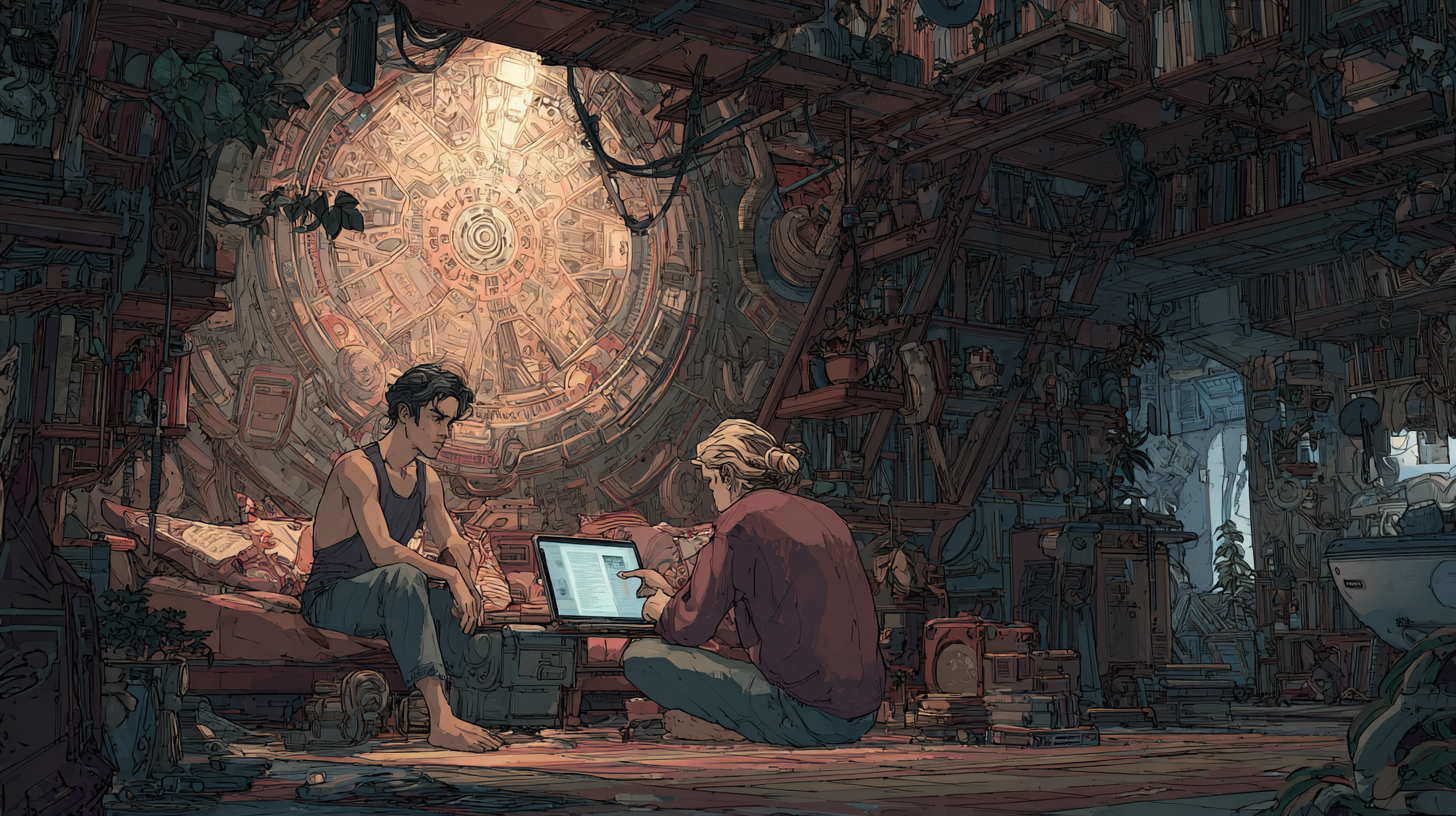
Outside the window, Brooklyn is alive with sirens and voices and the constant hum of the city.
But in here, we're excavating the past. Trying to understand how a kid playing Game Boy in Athens became a man dictating his Odyssey in New York.

The thread is there. I can see it now.
Growing up digital while the world was still analog.
Growing up between worlds while everyone else seemed to have just one.
Growing up searching for something real while everything around me felt fake.
That kid in Athens, sitting by the window, wondering why he didn't fit—

He's the same person sitting here now.
Still searching. Still between worlds. Still trying to find the real beneath all the constructed.
But now I have a framework. Now I have a story. Now I have a practice.
And that makes all the difference.

The journey gave me what Athens couldn't: permission to be exactly who I am.
An outsider. A bridge. A First Waver.
Someone who lives between the zero and the one, helping others make the crossing.
That's the role. That's the path.
And it all started in Athens, with a kid who didn't fit.
Thank God I didn't fit.
Because if I had, I'd still be there. Comfortable. Numb. Asleep.
And I'd never have woken up.