The taxi came at sunset to take me to the bus station.
I was leaving Tulum—leaving Oliver and Clara and the beach and that perfect frequency where everything made sense. The mood was heavy. That particular sadness you feel when you know you're leaving people you might never see again, people you didn't even know existed 48 hours ago but who've somehow become essential.
That's the nature of the journey. These moments that are so vibrant and full of life that you share with complete strangers. You never know if you're going to see them again. When you meet them for the first time, you don't realize the brevity of the time you'll spend together. Only when it's time to leave do you realize the uniqueness of what you shared.
We arrived at the bus station. The sun had set. Venus and the early stars were visible. It was an overnight bus—the seats reclined comfortably, but the air conditioning was on full blast. I put on a sweatshirt, pulled out my sleeping bag, and got comfortable by the window.
A crescent moon followed us into the night.
I stared out at it and let memories from the past couple of days bubble up. The trance floors. Tarquin's theory about the 0=1 shift. José Argüelles predicting 2012. Oliver's calm certainty that consciousness was accelerating.
I smiled. Giggled. Felt something catch in my throat as I replayed the last 48 hours, trying to process and understand the adventure unraveling in front of my feet.
The next thing I remember is someone gently nudging me: "Palenque. This is your stop."
I jumped up like I'd been hit by electricity, grabbed all my things, and a few seconds later I was standing on the side of the road watching the bus disappear into the morning mist.

Palenque bus station at pre-dawn
The sun hadn't risen yet, but it was light enough to see. There wasn't much around—the bus station was on the outskirts of town, not in the center. Two other people had gotten off with me. A couple. They were being greeted by this middle-aged woman with long, carefully groomed red dreadlocks.
She had a pickup truck and introduced herself as the owner of a yoga retreat in the jungle, very close to the Mayan ruins.
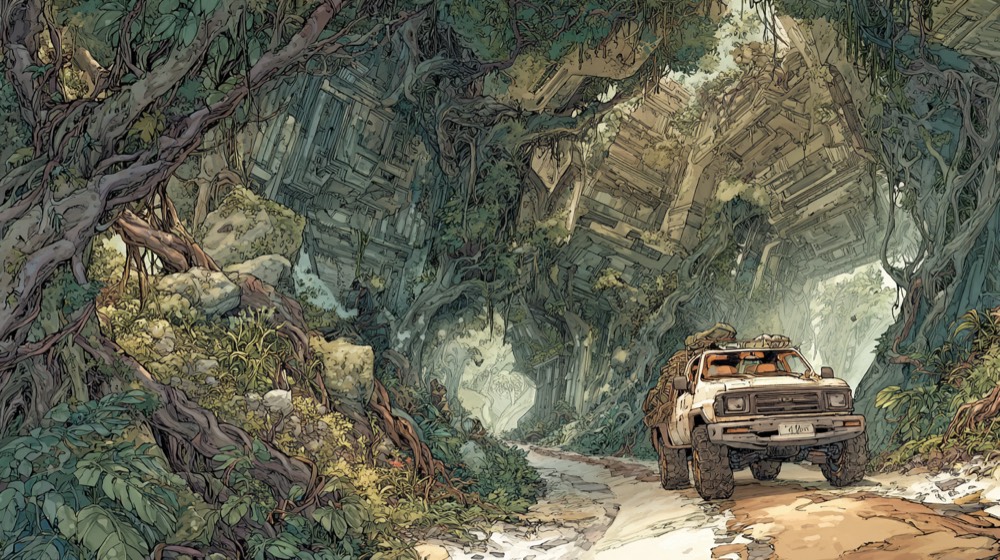
Pickup truck driving down muddy twisty jungle road
That's why I was here.
I'd heard about this temple built in the jungle—one that had only been discovered in the early 1900s. A real Indiana Jones lost temple situation. There was supposedly a river that went through the palace and waterfalls integrated into the architecture. Bathing pools built into the layout. Some sort of vacation retreat for Mayan royalty.
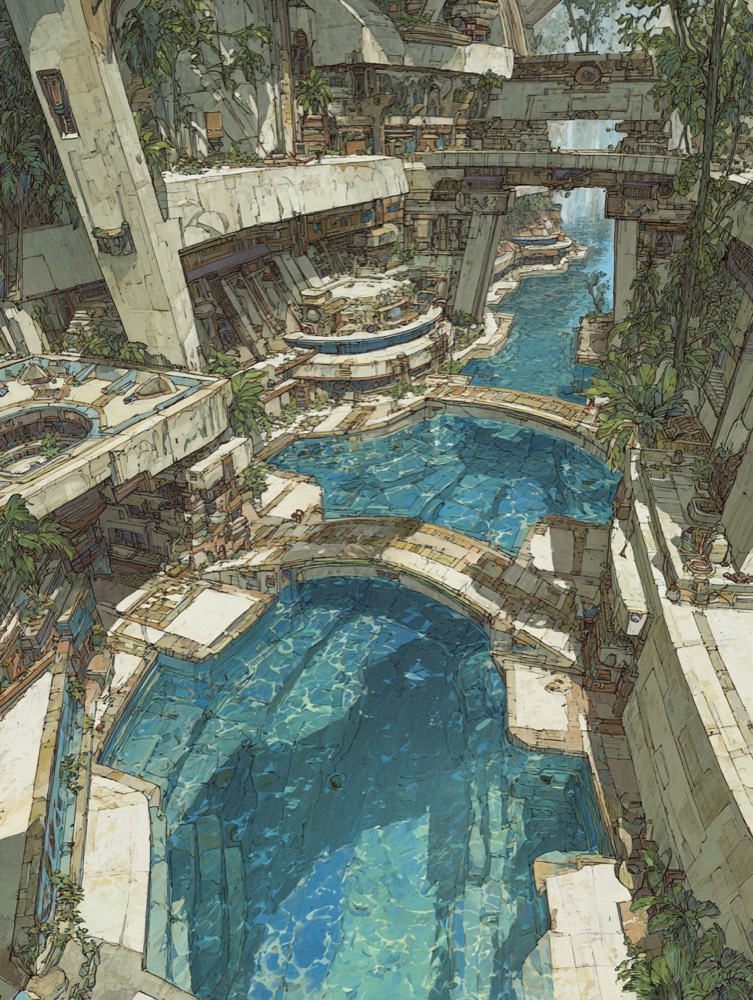
Mayan Palace interior with river flowing through stone architecture
I'd seen a few pictures but didn't know much. What I did know: a variety of eco-retreats, yoga and meditation centers had sprung up around the ruins. And this woman with the dreadlocks ran one of them.
I walked over to her. "Where are you going?"
"I have a retreat," she said. Her eyes were calm, her movements graceful and gentle. "Would you like a ride?"
"Do you have room?"
"Of course I have room. It's a big place. I have many options. If you want to sleep in a hammock, there's a mosquito-protected bay area. If you want a private room, you can have a private room. Everything in between. I'm sure you'll like it."
There weren't many other options. And I was looking for a place to stay.
"I'd love a ride."
I jumped into the back of the pickup truck with the couple. They were from Sweden, just a few weeks into their journey—also started in Cancun, like me. They'd been to Playa del Carmen but skipped Tulum. They were on their honeymoon.
Young. In love. Holding hands and staring into each other's eyes in that way that makes everyone else who's not in love slightly uncomfortable.
We drove down a dirt road that cut left just before the ruins. We entered the jungle—thick vines, leaves, branches. An auditory landscape infused with the impermanence of life. Insects, birds, rustling, breathing.
After a few turns on a twisty muddy road, an opening appeared.
And suddenly: this extraordinarily little compound of hobbit homes, bungalows, a community kitchen, an eating area, a yoga platform, a natural jacuzzi, and a scattered assembly of cottages nested in the tropical rainforest.
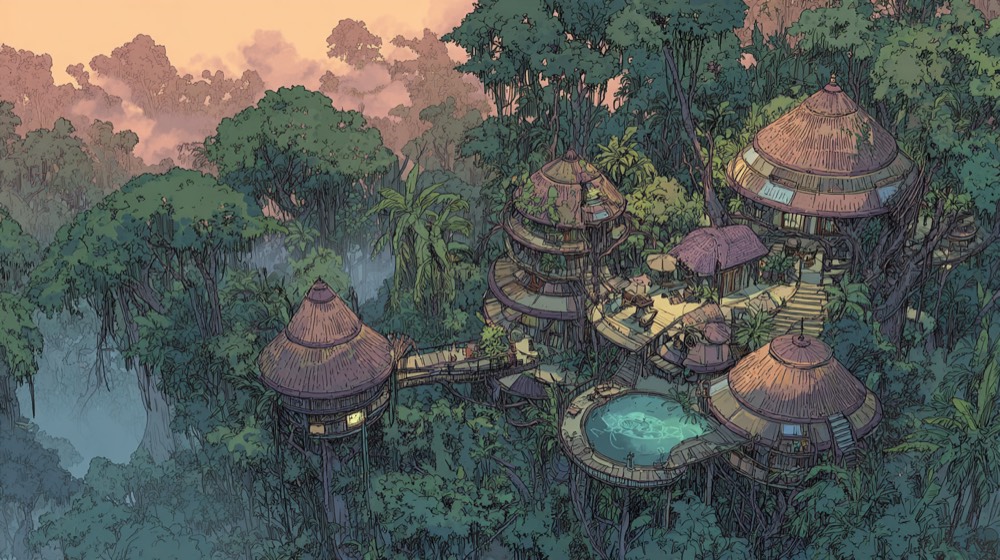
Jungle clearing revealing magical compound of hobbit bungalows
It was magical.
As soon as the engine of the truck cut off, this incredible peace transcended everything. As if the breath of the forest was textured with all the sounds made by the creatures that lived in it. Together, this voice had rhythm and intensity—a cadence that changed throughout the day as each creature, and ultimately all of them together, went through the cycle of their existence.
I walked over to the common area where the kitchen was and took off my backpack.
And that's where I met Dario.
Dario was one of the most special people I met throughout my entire journey.
He was in his early 30s, from Napoli, Italy. Long dreadlocks down to his waist. Thin. Moved elegantly and gently, like water.
He'd been traveling for ten years.
And claimed not to have used money for over five.
He spoke six languages. He also claimed not to have a passport or any kind of documentation—said he'd been traveling all over South America for the past decade, crossing borders in the jungle, not believing in the rules of people because he was free.
We got into many long conversations about the nature of freedom and what it means to be a human being and how to live a sacred life. I had so many questions about how one sustains themselves living that kind of marginal existence.
When I walked into the kitchen area, he was making tea.
"How are you?" he said, looking up. "Welcome. Where are you from? What's your name, my friend?"
"My name is Niko, and I'm from Greece."
"Oh!" His face lit up. "My name is Dario, and I'm from Italy. Very nice to meet you. I'm the chef here. I cook. But I also teach yoga—Ashtanga—every morning at 6 AM."
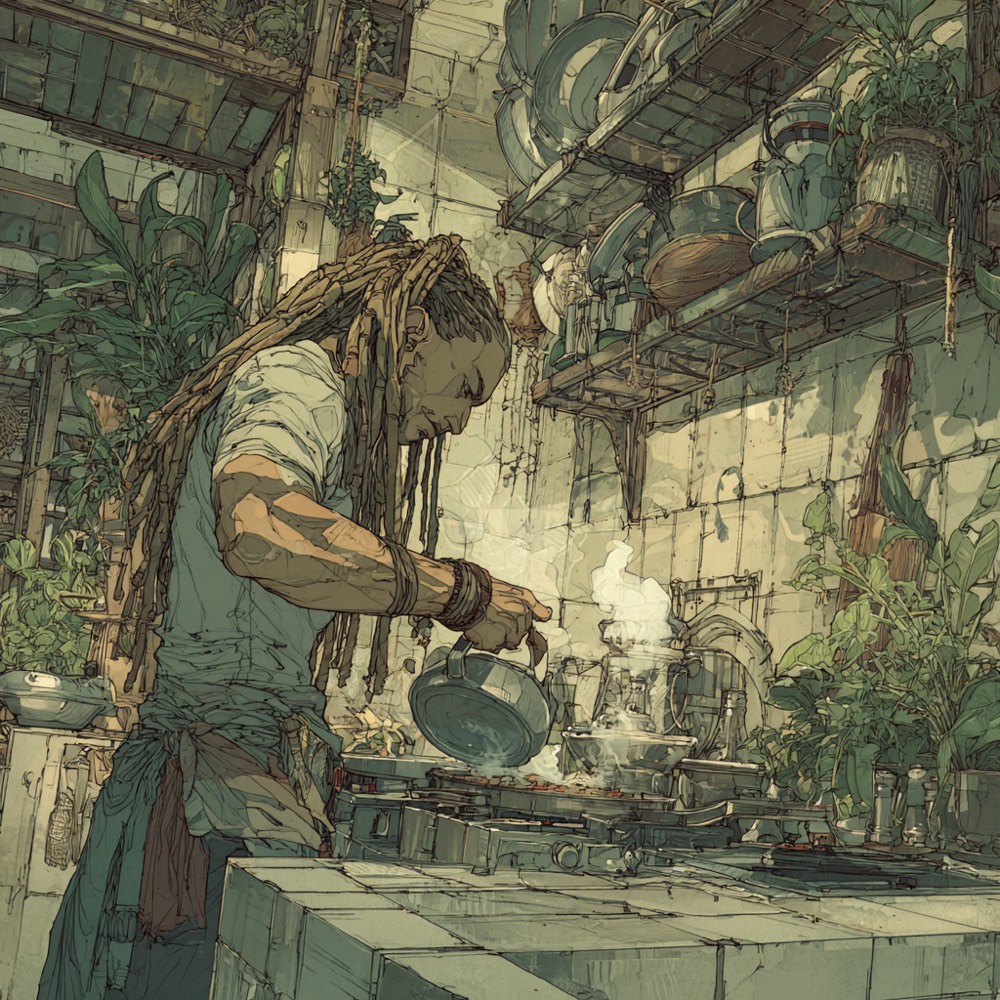
Retreat kitchen with Dario making tea
He poured me a cup of tea. As I was sipping this aromatic blend of herbs I couldn't identify, a young guy—no older than 17—wandered into the breakfast area. It was obvious he'd just woken up. He stretched, yawned, and poked around in the cupboard looking for something to eat.
Dario opened his arms, pointing at each of us.
"Yvonne, meet Niko from Greece. Niko, meet Yvonne from Mexico. Yvonne is a neurobiologist and is here to learn about the sacred plants of the Mayans and indigenous medicine. He just came from San Cristóbal de las Casas in Chiapas, where he was studying with a Mayan shaman."
I nearly dropped my tea.
"No way. That's where I just came from. Just now. It's been a wild journey."
Yvonne looked up from the cupboard. "No, not correct. That's where I'm *heading* soon. I'm going there after here. Perhaps you can give me some tips?"
"I'd love to. But first, I need to make myself some mate."
He pulled out a bag of crushed leaves, filled a funny little cup to the top with them, poured in boiling water, and let it sit for a few minutes. Then he poked it with a metallic straw and took three long sips.
His eyes went wide. Alert. Awake.
He rolled himself a cigarette and asked Dario to make him some eggs.
"So you're a neurobiologist," I said. "What are you particularly interested in? What kind of herbs?"
"All kinds of herbs." He sat down across from me. "You see, all plants have properties. Some are more pronounced than others. It depends also what you want them for—what are you looking to achieve?"
He took a drag from his cigarette.
"Plants have spirits. The spirits can do different things. Combining them together with other plants creates certain stories about how those spirits interact. Different effects can occur by mixing different plants together in different sequences."
"It's just a different understanding of how the recipe works," he continued. "I'm sure there's some scientific explanation based on chemistry and the compounds of each plant—that's what modern medicine is trying to replicate. But it goes beyond that. It's more subtle. More energetic. Less material. I'm really interested in understanding that viewpoint."
"Me too," I said. "That's exactly why I'm here."
I spent the next few days at the retreat, falling into the rhythm of the jungle.
6 AM: Dario's Ashtanga class on the yoga platform. The air still cool, mist rising from the trees, howler monkeys screaming in the distance.
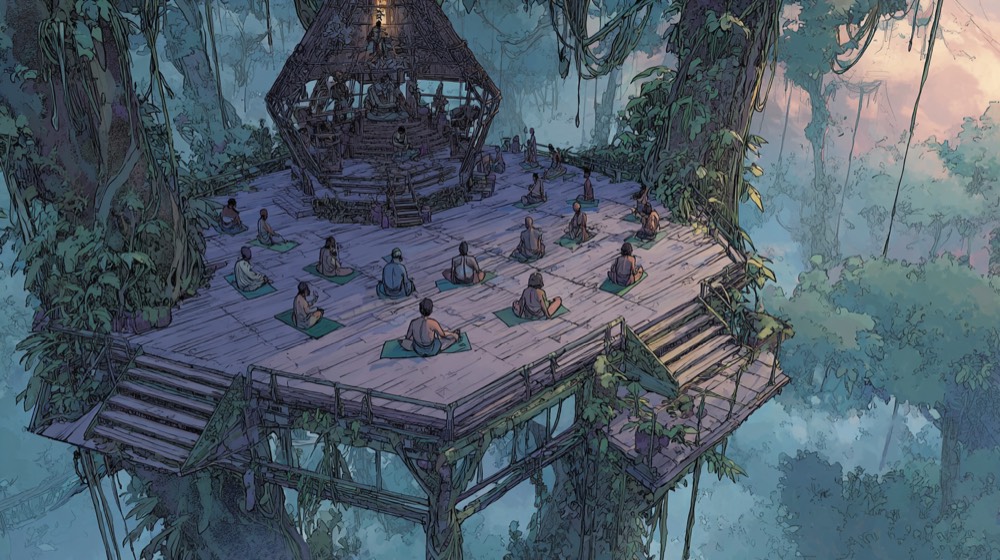
Palenque jungle yoga platform at dawn, Dario teaching Ashtanga
7:30 AM: Breakfast. Whatever Dario cooked—fresh fruit, eggs, beans, tortillas made by hand. Yvonne drinking his mate. The Swedish couple gazing at each other.
9 AM: Walk to the ruins. The temple complex emerging from the jungle like something out of a dream. The Palace. The Temple of Inscriptions. The river cutting through the stone. The sense that this place knew things we'd forgotten.
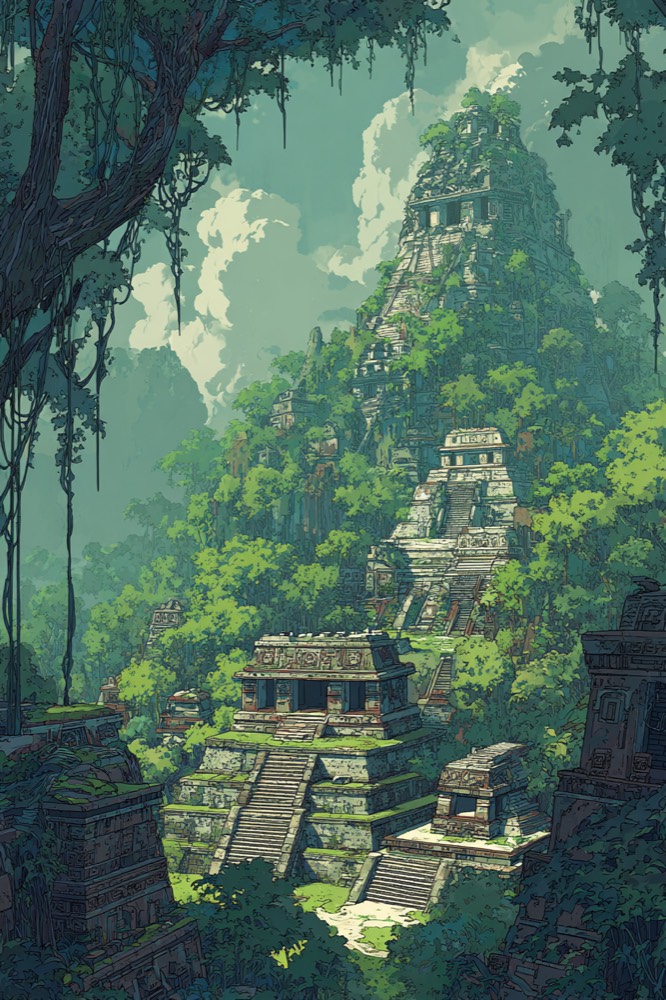
Palenque Mayan temple complex emerging from dense jungle canopy
Afternoon: Hanging in hammocks. Reading. Talking. Dario telling stories about traveling through Argentina, Bolivia, Peru without money—bartering skills, trading labor, relying on the kindness of strangers and the hospitality embedded in indigenous cultures.
"The Western world thinks you need money to survive," Dario said one afternoon while chopping vegetables. "But that's only true if you accept their game. Indigenous people—they've been living for thousands of years without money. They trade. They share. They understand that community is wealth."
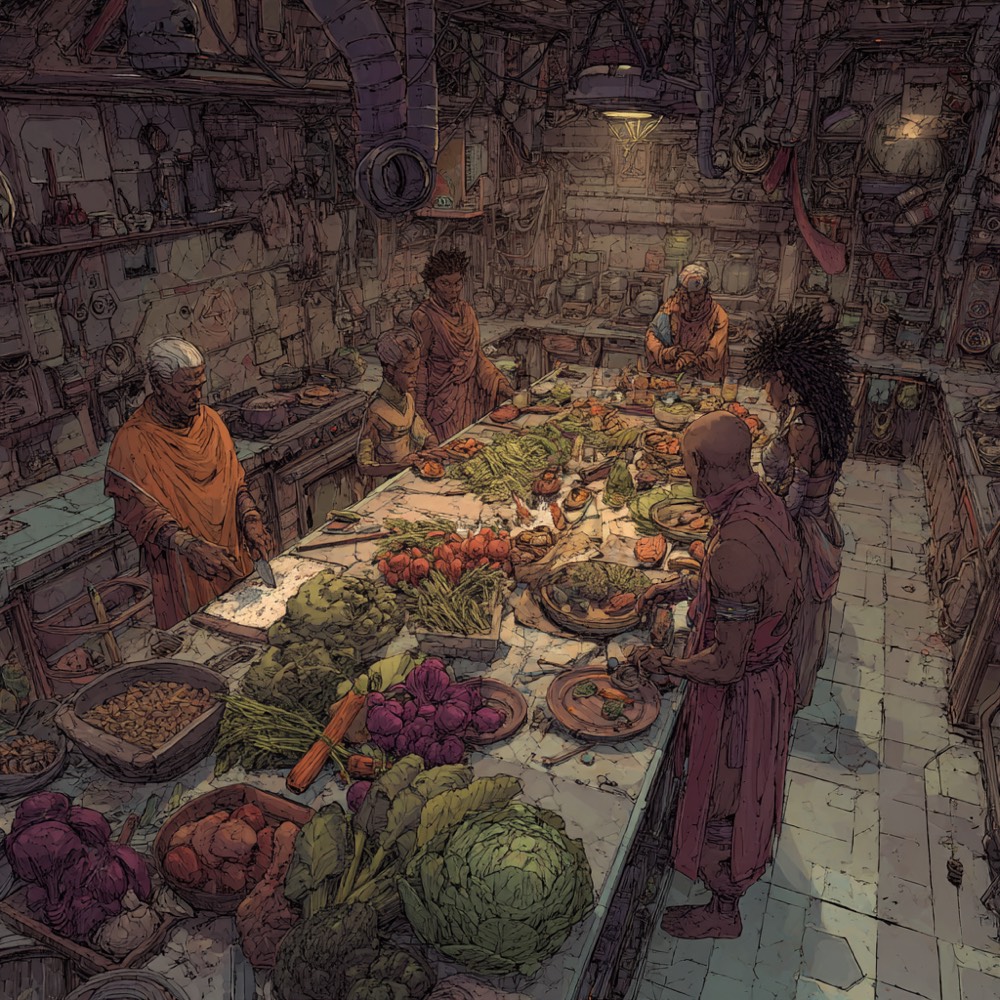
Retreat kitchen with Dario chopping vegetables
"But how do you cross borders?" I asked. "How do you deal with police?"
He smiled. "I walk through the jungle. The borders are lines on maps made by people who don't live there. The jungle doesn't recognize those lines. Neither do I."
Yvonne chimed in: "This is what I'm studying. Indigenous communities don't see themselves as separate from nature. Only Western man sees the natural world as something separate. Something you can take advantage of."
"Exactly," I said. "And that's part of the problem. That's why the world is so crazy. We're destroying the planet we live on because we don't understand it as a living, breathing organism."
Dario nodded. "We see ourselves as separate. That's the disease. And that separation creates all the other problems—war, greed, loneliness, destruction."
"But the plants," Yvonne said, leaning forward. "The plants can teach you. They can show you that you're not separate. That's why indigenous medicine works. Not just because of chemistry. Because the plants have intelligence. They can communicate."
I thought about the mushrooms in Tulum. The way they'd dissolved my boundaries. The way I'd felt connected to everything—the music, the dancers, the ocean, the sky.
"I believe you," I said.
One night, Dario made a feast.
Fresh fish from the river. Rice cooked with coconut milk. Grilled vegetables. A salad with herbs from the jungle that tasted like nothing I'd ever had—peppery, floral, almost electric.
We ate by candlelight in the common area. The Swedish couple. The woman with the red dreadlocks who owned the place. A few other travelers who'd arrived. Yvonne. Dario. Me.
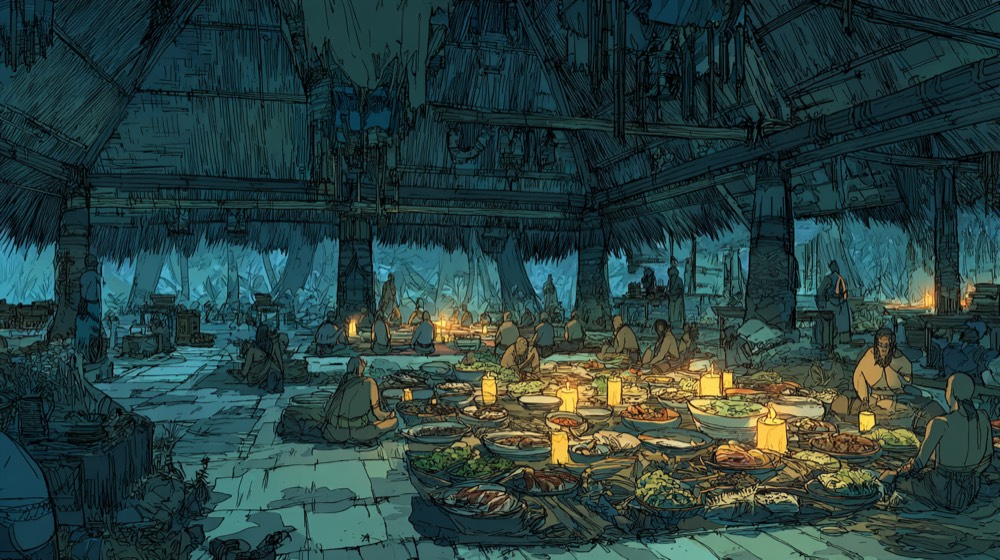
Palenque retreat common area at night, candlelit feast
And we talked about what we were afraid of.
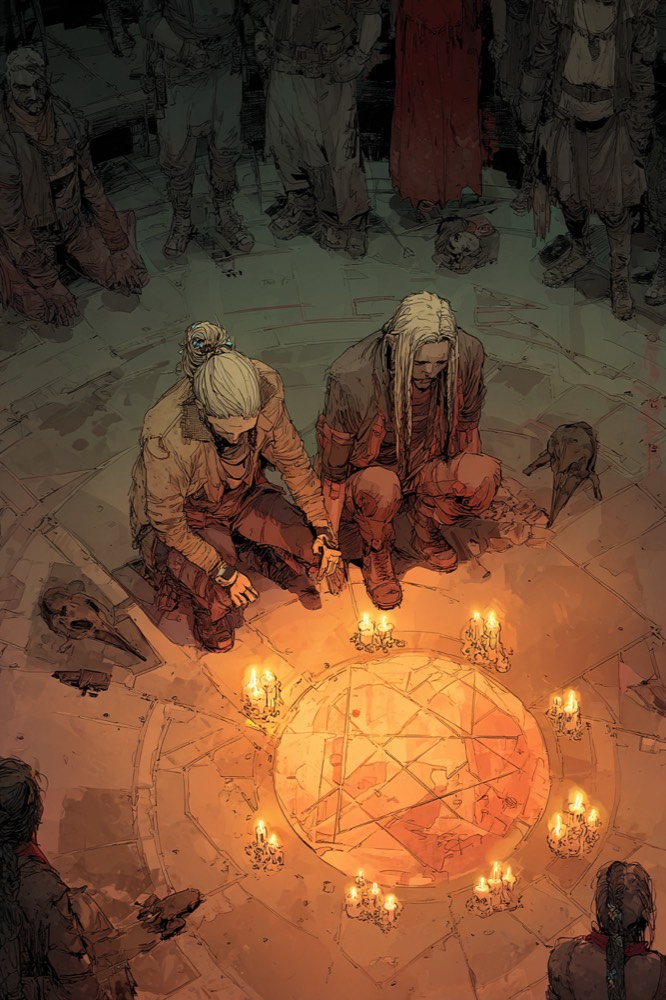
Candlelit circle of travelers sharing fears, Swedish couple holding hands
The Swedish guy said he was afraid of going back to his job. "We have two more months," he said, holding his wife's hand. "And then we go back to Stockholm. Back to the office. And I don't know how I'm going to do it after this."
His wife nodded. "We're different now. But Sweden will be the same."
The woman with the dreadlocks said she was afraid that places like this wouldn't exist much longer. "Tourism is coming. Development. In ten years, this will all be hotels and tour buses. The jungle will be cleared. The magic will be gone."
Yvonne said he was afraid that indigenous knowledge was dying. "The elders are passing away. The young people are moving to cities. In one more generation, most of this wisdom will be lost. No one will remember how to talk to the plants."
Dario said he wasn't afraid of anything. "Fear is a choice. I chose to be free. And freedom means accepting that anything can happen. Death, illness, arrest, whatever. I accept it. So I'm not afraid."
Then everyone looked at me.
"I'm afraid," I said, "that we're moving so fast into the future that we don't realize what we're leaving behind. All this progress, all this technology—it's incredible. But we're losing something. A way of seeing the world that's more metaphorical, more intuitive, more poetic. And before we know it, we're going to be all the same. There won't be these ancient, different, unique voices anymore. We'll have lost them."
Yvonne raised his mate cup. "That's why you're here. That's why we're all here. To remember. To witness. To carry it forward."
Dario smiled. "To be the bridge."
We drank to that.
On my last morning at the retreat, I woke up before dawn and walked to the ruins alone.
The jungle was still dark. The path barely visible. But I'd walked it enough times that my feet knew the way.
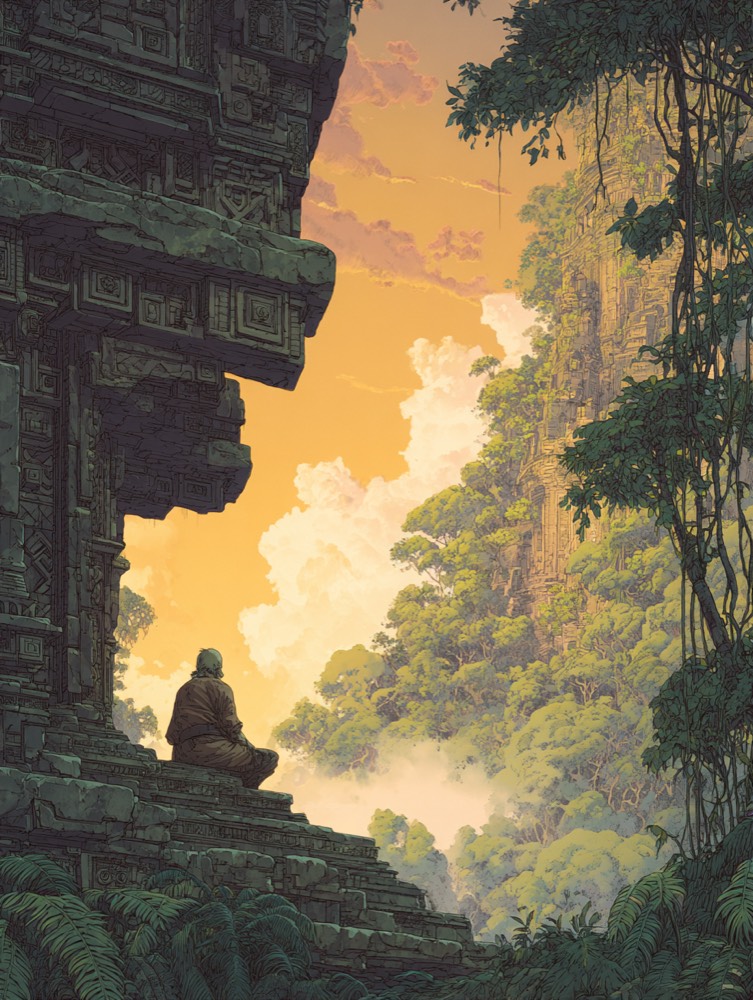
Lone figure sitting on Temple of Inscriptions steps watching sunrise over canopy
And I thought about what Dario had said: The separation is the disease.
Western civilization had built itself on the idea that humans are separate from nature. That nature is a resource to exploit. A problem to solve. Something to control.
But indigenous cultures—the Mayans who built this temple, the shamans Yvonne was studying, the communities Dario lived with—they saw it differently.
Nature wasn't separate. It was alive. Intelligent. Communicative.
The plants weren't just chemistry. They were teachers.
The jungle wasn't just biology. It was a network. A living system. A conversation happening at a frequency we'd forgotten how to hear.
And the temples—places like this—they weren't just architecture. They were interfaces. Places where humans could plug into that larger conversation. Where the boundary between self and world dissolved. Where you could remember what it felt like before the separation.
I thought about the internet. About Jim's idea of the noosphere—the global brain forming through our connections. About how the trance floors felt like a modern version of this temple: a place where individual consciousness dissolved into collective consciousness, where separation gave way to unity, where you remembered you were part of something larger.
Maybe that's what we were doing. All of us travelers. All of us dancers. All of us seekers.
Maybe we were trying to rebuild the bridge. To find the frequency again. To remember how to hear the conversation that the indigenous world never forgot.
Not by going backward—you can't un-invent technology.
But by going deeper. By carrying the wisdom forward. By being the bridge between the ancient voice and the future world.
The sun broke over the canopy, golden light flooding the temple steps.
I stood up.
I had to keep moving. San Cristóbal was next. Then Peru. Then wherever the path led.
But I'd carry this with me: Dario's freedom. Yvonne's curiosity. The jungle's intelligence. The temple's memory.
The understanding that separation is the disease.
And connection is the cure.
I'm writing this in New York now, July 2002, eight months after leaving Palenque.
I never saw Dario again. I heard from someone that he made it to India. Then Thailand. Still traveling. Still free. Still refusing to accept that money is necessary or borders are real.
I never saw Yvonne again either. But I think about him sometimes when I see pharmaceutical companies patenting indigenous plant knowledge. When I read about the Amazon being burned. When I wonder if the wisdom he was trying to learn is still being passed down or if it's already gone.
The retreat is probably still there. Maybe it's been developed. Maybe the woman with the dreadlocks sold it. Maybe the jungle reclaimed it.
But what I learned there—that stayed.
Here's what Palenque taught me:
You don't need money to be free. You need courage.
You don't need a passport to travel. You need trust.
You don't need to own things to be wealthy. You need connection.
And the separation between self and nature—that's not reality. That's a story we tell ourselves. A very profitable story for some people. But a story nonetheless.
The truth is: we're not separate. We never were. The jungle knows it. The plants know it. The indigenous elders know it.
And somewhere deep down, beneath all the conditioning and programming and separation, we know it too.
We just forgot.
But we can remember.
That's what the journey is for.
That's what the temples are for.
That's what the teachers like Dario are for—to show us that another way is possible.
Not better. Not worse. Just different.
More connected. More alive. More free.